(answer to a 260606 question on myteapal discord) :
this is a very deep and important question.
it touches the heart of japanese identity, and therefore resonates with many conflicting emotions — pride, shame, embarrassment, curiosity, and so on — passing through the different layers of both ancient and recent history.
even a cultivated japanese person is lost when faced with chinese appellations.
he does not know how to pronounce them.
each kanji in japanese can be pronounced in many different ways, depending on whether the character stands alone or appears in a compound. some of these readings are derived from ancient chinese pronunciations, but without tones, which explains the large number of homonyms.
in japanese, words are often compounds made of two ideograms. this compound unit determines the pronunciation, and there are no rules. only usage makes it possible to know that, in a given combination, a given character is read with a given sound.
when faced with a new, unprecedented combination, the absence of established usage makes it impossible to determine the pronunciation with certainty. a japanese speaker will then use the statistically most probable reading.
another contemporary factor is that simplified chinese characters are not automatically recognized.
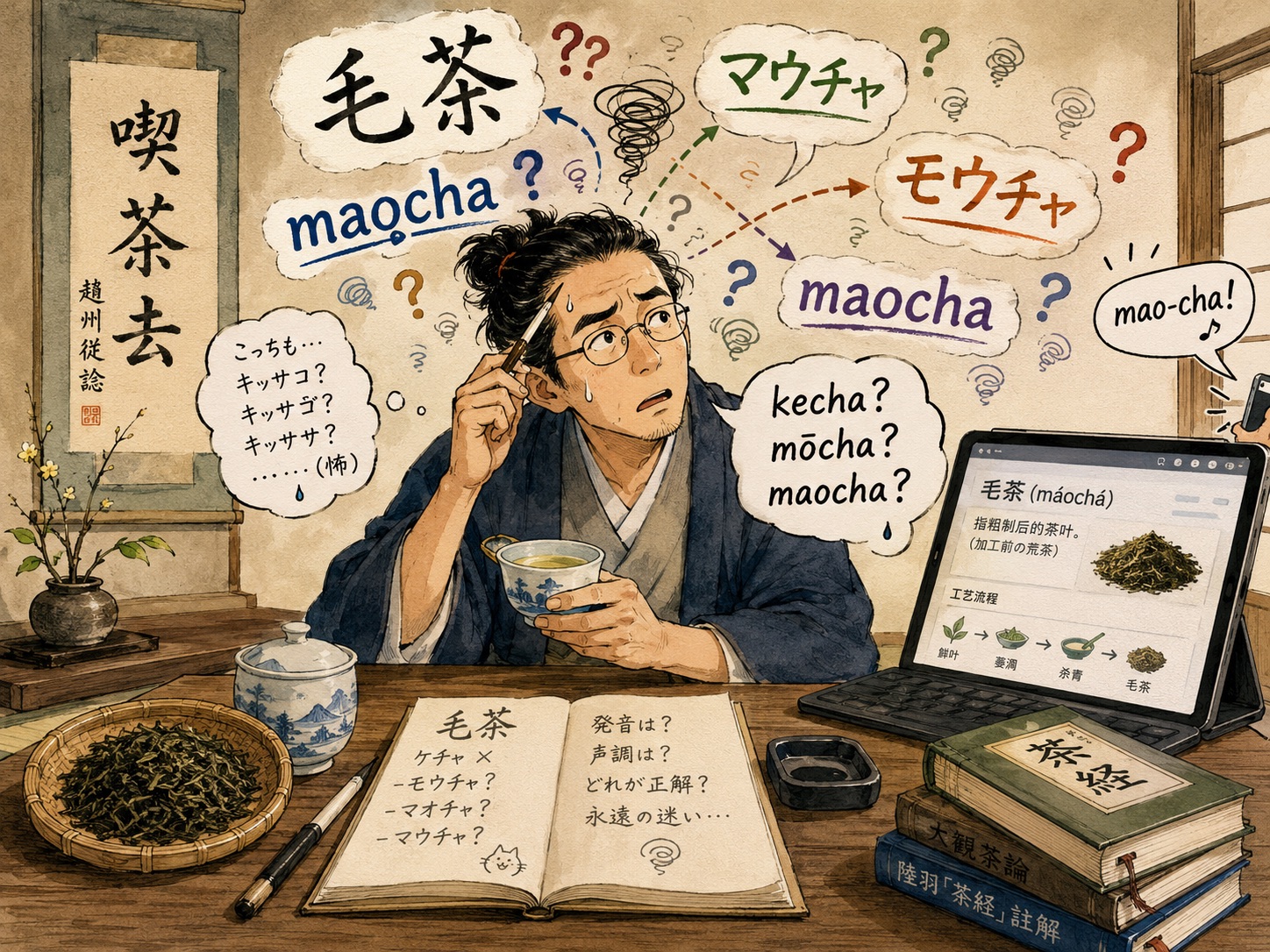
faced with a word such as 毛茶 — kecha? mōcha? — he will have access to a general meaning: downy tea? tea made from first buds? but he will not identify its possible specific and specialized meaning: loose, unpressed tea.
for all specialized tea vocabulary that has not been translated, he will therefore use one of the japanese phonetic syllabaries, katakana — モウチャ — which is used to indicate the pronunciation of foreign words, in order to name this word. and the romanized transliteration — maocha — is not always immediately associable with the katakana form.
so, on an online site displaying simplified chinese characters and the word in roman alphabet, he will not really know how to pronounce the word.
this creates a cognitive obstacle that leads him to “abandon” the sonic reading, to associate the object only with the written characters, and then to feel lost when someone speaks the chinese word using a “western” sound-based version.
this is especially true for all names of terroirs and places.
therefore, for a document on technical tea terminology intended for japanese readers, the ideal solution is to include the simplified and traditional chinese characters, the romanized form, and the “phonetic” reading in katakana.
there is one last difficulty: the sounds produced by katakana are limited and create a strong accent. a japanese speaker will always pronounce a foreign word through its katakana pronunciation. and it often happens that the japanese transliteration is not the closest possible approximation.
for example, maocha is written in katakana as モウチャ, which is pronounced mōcha.
this issue was even more complex in the past when reading chinese texts, and a sophisticated system was created to address the problem.
a recent video on youtube explains the principle:
https://www.youtube.com/watch?v=q5hpatMC1Wc
a cultivated contemporary japanese person no longer knows how to use this system. there are introductions to it at school, but they are too brief and quickly forgotten, because they are never sustained by actual practice.
this question of the ancient reading of chinese texts is encountered in the world of japanese tea ceremony when the scroll displayed in the tokonoma bears a zengo, a chinese quotation from a zen/chan text, which must be commented on by giving its reading in japanese.
for anyone who appreciates the aesthetics of tea tasting, the association of poetry, philosophy, and calligraphy with the act of tasting opens a world of deep joys. if you have not yet discovered zengo, i warmly recommend this path to you.
kuma
français
c’est une question très profonde et importante.
qui touche au coeur de l’identité japonaise et qui vibre donc de nombreuses émotions antagonistes (fierté, honte, embarras, curiosité, etc) passant par les différentes couches d’histoires anciennes et récentes.
un japonais même cultivé est perdu devant les appellations chinoises.
il ne sait pas les prononcer.
chaque kanji en japonais peut se prononcer de nombreuses façons. quand le kanji est isolé ou associé (un dérivé de la prononciation chinoise ancienne sans les tons, ce qui explique le grand nombre d’homonymes).
en japonais les mots sont souvent des composés de deux idéogrammes. cette unité décide de la prononciation et il n’y a pas de règles. seul l’usage permet de savoir que dans telle combinaison, tel caractère se lit avec tel son.
face à une nouvelle combinaison inédite, l’absence d’usage rend impossible la détermination sûre de la prononciation. un japonais utilisera alors la plus statistiquement probable.
autre élément contemporain, les idéogrammes simplifiés ne sont pas automatiquement reconnus.
face à un mot comme 毛茶 (kecha ? môcha ?) : il aura accès à un sens général : thé duveteux ? composé de premier bourgeon ? mais n’identifiera pas l’éventuel sens spécifique et spécialisé : thé en vrac non pressé.
pour tout le vocabulaire spécifique du thé qui n’est pas traduit, il utilisera donc l’un des syllabaires phonétiques du japonais, le katakana (モウチャ) qui sert à donner la prononciation des mots d’origine étrangère, pour nommer ce mot. et la translitération en alphabet romain (maocha) n’est pas toujours immédiatement associable au katakana.
donc sur un site en-ligne avec les idéogrammes simplifiés chinois et le mot en alphabet romain, il ne saura pas vraiment comment prononcer le mot.
cela crée un obstacle cognitif qui les conduit à « abandonner » la lecture sonore pour associer à l’objet uniquement les caractères et à se retrouver perdu quand on parle du mot chinois en utilisant une version sonore « occidentale ».
c’est particulièrement le cas pour tous les noms de terroirs et de lieux.
donc pour un document sur des mots techniques de thé pour des japonais, l’idéal est de mettre, les idéogrammes simplifiés et traditionnels, le mot en alphabet romain, et la lecture « phonétique » en katakana.
dernière difficulté, les sons produits par le katakana sont limités et crée un « fort accent ». un japonais prononcera toujours un mot étranger avec la prononciation « en katakana ». et il arrive régulièrement que la translitération en japonais ne soit pas la plus proche.
exemple : maocha est écrit en katakana モウチャ qui se prononce môcha…
cet enjeu était encore plus complexe dans le passé pour la lecture des textes chinois et un système sophistiqué a été créé pour adresser ce problème.
une vidéo récente sur youtube en explique le principe :
https://www.youtube.com/watch?v=q5hpatMC1Wc
un japonais cultivé contemporain ne sait plus utiliser ce système (il y a des introductions à l’école mais trop courtes et vite oubliées car jamais actualisées par une pratique).
cette question de la lecture ancienne des textes chinois se rencontre dans le monde de la cérémonie du thé japonaise quand le rouleau affiché dans le tokonoma porte un zengo, une citation chinoise d’un texte zen/chan qu’il faut commenter en donnant sa lecture en japonais…
pour qui apprécie l’esthétique d’une dégustation de thé, l’association de poésie / philosophie / calligraphie à la dégustation ouvre un monde de joies profondes et si vous n’avez pas encore découvert les zengo, je vous recommande chaleureusement ce sentier !
kuma
Vous devez être connecté pour poster un commentaire.